Software-Based Network Expert Nurtures Future Talent at University for Over 20 Years... "GPU Performance Varies Dramatically Depending on Connection Methods"
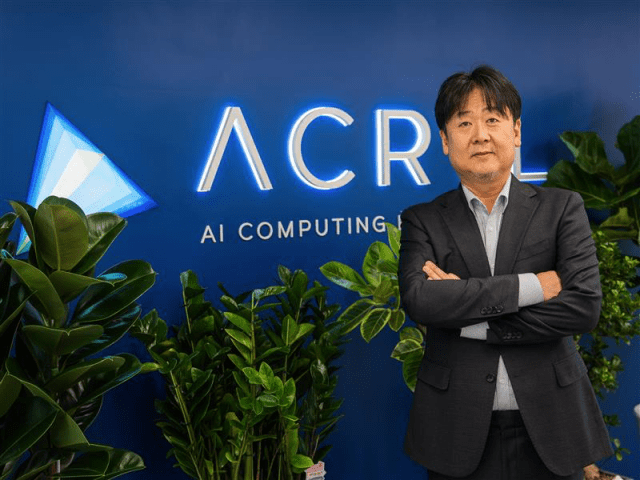
Ikjun Yeom, CTO of ACRYL, is also a professor in the Department of Software at Sungkyunkwan University. Having nurtured future talent at the university for over 20 years, he is an expert in software and networking. Since 2021, he has also served as CTO of AI specialist company ACRYL.
ACRYL is a company specializing in AI infrastructure and platforms. It helps enterprises and institutions efficiently develop, operate, and scale AI. The company's market potential and technological capabilities have been recognized through its selection as one of Forbes Korea's "Top 50 AI Companies in Korea" for two consecutive years (2024, 2025). Despite the sluggish investment market last year, the company successfully listed on KOSDAQ in December.
On the 1st, Professor Yeom explained his dual role as ACRYL's CTO: "After my first faculty appointment in 2002, I conducted numerous government-funded research projects, published papers, and filed patents over more than 20 years. However, the technologies born in the lab remained confined to academic papers and never translated into real changes in our lives. I always felt a sense of regret and longing about this. Joining ACRYL was driven by that desire for 'connection.' I'm excited and thrilled to be able to implement the theoretical depth I've built at school into actual services and products."
ACRYL's flagship products are 'Jonathan' and 'NADIA.' 'Jonathan' is an integrated AI platform that automates AI development, deployment, and operations. It supports the entire process from data collection to model training and deployment, making it easy for enterprises to adopt AI. In particular, the GPU operation optimization technology embedded in 'Jonathan' maximizes the utilization efficiency of GPU resources that cost tens of millions of won each.
'NADIA' is an AI solution specialized for medical healthcare. It structures and standardizes medical data and supports multiple languages. It is a global healthcare-specialized AX platform that connects everything from Hospital Information System (HIS)-based operations to SaMD (Software as a Medical Device)-grade diagnosis and prediction in a single workflow.
When asked if juggling the roles of professor and CTO was difficult, CTO Yeom responded by saying "the synergy between the two roles is clear." According to him, the first benefit from performing both roles is 'talent connection.' In fact, led by Dr. Euiyeol Ko (Director) and Dr. Sugi Lee (Division Head) from Professor Yeom's lab, many talented master's and doctoral students are now core personnel at ACRYL's research center. CTO Yeom expressed his enthusiasm: "The fact that students I personally taught and worked closely with at school have now become reliable colleagues working toward the same goals outside the university is my greatest asset."
Another attraction is the 'virtuous cycle of experience.' CTO Yeom shared: "The vivid problem-solving experiences and latest trends from the industrial field at ACRYL become valuable foundations for teaching students and guiding research back at school. A structure has been completed where theory leads the field, and field experience enriches education."
CTO Yeom graduated from Yonsei University (Electronic Engineering). He received his master's and doctoral degrees in Computer Engineering from Texas A&M University. After obtaining his doctorate, he began his academic career as a professor in the Department of Computer Science at KAIST (2002-2008), spending seven years there before moving to his current position at Sungkyunkwan University in 2008.
He has a 'special connection' with Oejin Park, CEO and founder of ACRYL. They are alumni from the same high school (Gaepo High School). Both were class presidents in their senior year, indicating their academic excellence and leadership.
After graduating from high school, they went their separate ways (CEO Park entered KAIST, Professor Yeom entered Yonsei University) and reunited at KAIST in 2002. At that time, Professor Yeom was a newly appointed professor in the Department of Computer Science, while CEO Park was a doctoral student in Computer Science and an entrepreneur running a startup.
CTO Yeom explained: "We had different backgrounds. I was a professor specializing in 'networking,' and CEO Park was a businessman specializing in 'software engineering.' Our fields of expertise and social roles were different. That's precisely why we could become perfect partners. This naturally formed a complementary relationship where we filled each other's gaps. Based on this trust, when ACRYL was founded in 2011, I participated more actively in R&D, and while sharing our technological vision, I naturally took on the important role of CTO in 2021. The time we've built as longtime friends and colleagues has created our solid teamwork today."
Below is a Q&A interview with CTO Yeom. In this interview, he emphasized: "Having Korea's system software technology become the standard for global AI infrastructure—this is my ultimate goal as both a scholar and CTO."
[Expertise Integration] As a professor, your main research areas are 'networking' and 'systems.' Typically, AI companies seek to recruit model researchers. What was the background for an infrastructure expert joining an AI company like ACRYL?
"ACRYL is fundamentally different from the typical AI startups that have recently sprung up everywhere. When we were founded in 2011, 'artificial intelligence' wasn't receiving the attention it does today. At that time, our core item was 'Affective Computing.' Our goal was to understand human emotions by integrating various multimodal data including text, voice, and facial expressions. To best implement this, we actively adopted deep learning and AI technologies. AI was not the purpose but an essential tool for solving problems.
This is also why my expertise in networking and systems technology is essential. While processing large volumes of video and audio data for emotion recognition, we found that if the 'network' carrying data was slow, no matter how expensive the GPU, inefficiency occurred where the GPU would sit idle waiting for data to arrive.
I focused on system optimization to resolve this bottleneck, and as a result, I experienced firsthand that 'AI performance depends not only on the model but also on the infrastructure (system & network) that supports it.' Recently, the global industry is also re-examining the importance of 'AI infrastructure' beyond model competition. ACRYL is a company that has grown from its inception based on this systematic thinking."
[R&D Philosophy] Despite being a startup, ACRYL publishes papers at the world's most prestigious conferences every year. In a market where product development speed is fiercely competitive, why do you focus on fundamental technology research?
"Paradoxically, we conduct in-depth research 'to survive in the fastest-changing market.' AI technology advances so rapidly that yesterday's new technology can become outdated today. If you're only focused on commercializing technologies others have created, you'll inevitably fall into a vicious cycle of becoming obsolete before even launching a product. The only way to break this cycle is to secure 'fundamental technologies ahead of others.'
Our annual publications at prestigious conferences go beyond academic achievement—it's a process of having our technological advantages objectively verified and recognized on the global stage. We also aim to expand the ecosystem pie by publicly sharing this technology rather than monopolizing it. A representative example is releasing our in-house developed 'Jonathan' platform as open source under the name 'Tango 2.'
Fortunately, this R&D philosophy is translating into actual results. When LLMs first emerged, everyone focused only on model tuning, but we looked ahead and concentrated on 'infrastructure technology for resource-efficient inference.' The market is now moving exactly in the direction of 'cost reduction and efficiency' that we prepared for. I believe we were able to lead the market because we researched and prepared for areas others didn't see. Honestly, there's a bit of personal 'ambition' mixed in too (laughs). While I'm a company CTO, I'm also a scholar who has focused on research for over 20 years. So there's an 'researcher's desire' to produce meaningful research results and gain recognition that I just can't help (laughs)."
[Product Introduction] What kind of solution is 'GPUBase,' ACRYL's core product? What value does it provide to cloud operators (CSPs) and users?
"GPUBase is ACRYL's flagship product, born from combining my expertise in networking and systems technology with ACRYL's AI technological capabilities. In short, it can be defined as 'a GPU management and operation platform that maximizes AI infrastructure performance.' Serious inefficiencies exist in AI operations. Even after purchasing expensive GPUs costing tens of millions of won each, actual utilization is often only 50-60%. This is because data doesn't arrive on time or scheduling gets tangled, leaving GPUs idle for extended periods. 'GPUBase' plays the role of finding this 'hidden inefficiency' and converting it into performance.
The core technologies are divided into two axes: 'computing optimization' and 'communication optimization.' On the computing side, we enhanced and combined NVIDIA's MPS (Multi-Process Service) and MIG (Multi-Instance GPU) technologies. This allows a single high-performance GPU to be precisely divided into multiple logical units or dynamically allocated according to workload, eliminating resource waste at the source.
What I want to emphasize even more is the network (communication) technology, which is my primary field. To resolve bottleneck phenomena when hundreds of GPUs simultaneously exchange data, we applied 'Multipath Transport' technology and 'Traffic Differentiation' technology. This involves creating multiple data highways and assigning priorities to important data, minimizing transmission delays. This allows GPUs to perform computations continuously without stopping.
This technological stability has been externally verified as well. We recently joined the 'NVIDIA Connect Program' as a member. This means our solution has been officially verified for technical compatibility within the NVIDIA ecosystem. From the customer's perspective, this provides additional grounds for confident adoption.
As a result, users can train and run more AI models for the same cost, significantly reducing TCO (Total Cost of Ownership). Cloud operators (CSPs) can provide premium services that guarantee high-performance AI environments beyond simple infrastructure rental."
[Differentiation] Various GPU management tools exist in the market. What are the technical differentiators or unique architecture that only GPUBase possesses compared to competing products?
"The most decisive differentiator lies in 'network technology independence and optimization.' Currently, most competing products in the market are entirely dependent on NVIDIA technology (NVLink, InfiniBand, etc.) for network performance. They vaguely believe 'it must be fast because we're using NVIDIA equipment.' However, this passive approach has two critical limitations. First, there's the 'vendor lock-in' problem. If you rely only on specific vendor technology, flexibility significantly decreases when expanding or changing infrastructure in the future, and cost control becomes impossible.
Second, more importantly, there's the 'absence of additional optimization.' NVIDIA only lays down very fast 'roads (network equipment)'; they don't completely handle the 'traffic management (topology optimization)' of how vehicles (data) should travel to avoid congestion. Performance varies dramatically depending on data center structure and connection methods (topology), but competitors overlook this. GPUBase targeted precisely this point. We don't rely solely on hardware performance; we analyze the given topology environment and precisely control data flow through software. In other words, while others trust only the 'fast road' and drive, we provide 'optimal navigation,' extracting 100% or more of the hardware's potential. This is the distinctive technological capability of ACRYL's GPUBase that I'm proud of as a network expert."
[Market Outlook] Recently, 'Ethernet-based RoCE (pronounced "rocky")' is gaining attention in the AI infrastructure market instead of expensive InfiniBand. As a networking authority, how do you view this trend, and what technical preparations is ACRYL making?
"InfiniBand is a dedicated high-performance network, and RoCE (RDMA over Converged Ethernet) is an Ethernet-based RDMA technology competing with InfiniBand. Many people think the shift from InfiniBand to RoCE is simply due to 'cost reduction,' but from a network expert's perspective, the fundamental issue is 'vendor lock-in.'
InfiniBand is closer to a closed ecosystem led by a specific vendor. But now the AI market is entering a 'Warring States period' of hardware with various NPUs and accelerators emerging beyond NVIDIA GPUs. If you're locked into a specific company's network technology, there will be significant constraints on freely adopting and utilizing these diverse next-generation accelerators.
This is precisely why global big tech companies including AMD, Intel, and Meta have recently formed the 'Ultra Ethernet Consortium (UEC)' centered around the Linux Foundation. A massive movement has begun to create a high-performance AI network ecosystem through the open standard Ethernet instead of closed InfiniBand.
ACRYL has been anticipating and preparing for this change for several years already. In fact, in 2021, I published a paper titled 'GPU-Ether: GPU-native Packet I/O for GPU applications on Commodity Ethernet' at 'IEEE INFOCOM,' the world's most prestigious networking conference.
This paper was pioneering research that academically and technically demonstrated that 'GPU Direct RDMA (direct data transfer between GPUs)' technology, which had been considered exclusive to InfiniBand, could also be implemented in regular Ethernet environments. While others were complacent with InfiniBand, we had already secured fundamental technology to maximize GPU performance over Ethernet.
In conclusion, ACRYL possesses 'prepared technological capabilities' to deliver optimal performance on any hardware, whether customers use InfiniBand or RoCE."
[Scalability] Due to NVIDIA GPU shortages, various AI semiconductors (NPUs, etc.) are emerging. Can ACRYL's GPUBase be applied in non-NVIDIA chipset environments?
"Absolutely. Even before the NVIDIA GPU shortage occurred, we had been steadily making technical preparations for the post-NVIDIA era by collaborating with major domestic NPU companies. First, we've already completed verification of software compatibility through various government-funded projects.
We're participating in the 'PIM-NPU-based Large Neural Network Processing Platform' project led by Rebellions, and the 'Commercial Edge AI SoC Semiconductor SW Platform' development with DeepX and Mobilint, working together until 2027 to create system software for next-generation semiconductors.
Additionally, ACRYL is leading a project to develop 'Federated Learning and Inference Framework between Data Centers and Edge NPUs,' solidly building our NPU support capabilities. On top of this, ACRYL's powerful weapon, 'network technology,' is also a significant strength.
While competing products depend on NVIDIA-exclusive network technology, making expansion difficult, our network optimization technology is independent technology not dependent on NVIDIA hardware. Therefore, regardless of what type of AI semiconductor enters the market in the future, we can support optimal performance without being constrained by hardware characteristics."
[Future Trends] 'Physical AI,' where AI moves from virtual spaces to the physical world through robots and other devices, is a hot topic. What is ACRYL's response strategy or vision for this?
"The core of the Physical AI era is the VLA (Vision-Language-Action) model, where AI goes beyond simply seeing (Vision) and speaking (Language) to performing physical actions (Action). ACRYL aims to lead this trend through our core platform 'Jonathan.' We're currently advancing Jonathan to effectively support and incorporate various VLA models. However, in Physical AI, the network is just as important as the 'intelligence (Brain).'
This is because for robots to move in real-time on-site, even 0.1 seconds of data delay is unacceptable. This is where ACRYL's secret weapon 'GPUBase' shines. Our 'Traffic Differentiation technology' selects and prioritizes the transmission of core signals necessary for robot control from among countless data streams. This enables seamless real-time control even when hosting large-scale Physical AI.
For this technology development, we're currently collaborating closely with Professor Honguk Woo's research team at Sungkyunkwan University, an authority in the Physical AI field. Our goal is to combine the university's fundamental technology with ACRYL's infrastructure technology to create the standard operating system (OS) for the coming robot era."
[Ultimate Goal] As ACRYL's CTO and a scholar standing at the podium, what is the technological goal you ultimately want to achieve?
"We need to look at reality soberly. Although Korea is called one of the top three AI powerhouses (G3), the gap with the first and second-place countries is still significant. Especially in fields like LLMs where overwhelming data volume determines success, it's realistically difficult for us to compete on all fronts. Therefore, the strategy we need now is 'selection and concentration.' I'm convinced that the winning battleground is 'system software.' NVIDIA was able to build its current AI empire not simply because of hardware performance, but because it had a powerful software ecosystem called 'CUDA.'
Korea is also producing competitive AI semiconductors (NPUs), but for these to succeed in the global market, 'system software' capabilities to perfectly control and support the hardware are essential. My goal is clear. To build a 'Korean CUDA' ecosystem with ACRYL's technology. Creating a solid software foundation so that domestic AI semiconductors can be used anywhere in the world without obstacles, and nurturing convergent talents at school who can see through both software and hardware—these two things are my ultimate goals."
◆About Ikjun Yeom
Education
- Ph.D. in Computer Engineering,
Texas A&M University (2001)
- M.S. in Computer Engineering,
Texas A&M University (1998)
- B.S. in Electronic Engineering, Yonsei University (1995)
Career
- CTO, ACRYL (2021-Present)
- Professor, Department of Software,
Sungkyunkwan University (2008-Present)
- Professor, Department of Computer Science, KAIST (2002-2008)
Key
Related Publications
- Perf: Preemption-enabled RDMA
FRAMEwork, USENIX ATC, 2024
- I-NVMe: Isolated NVMe over TCP for
a containerized environment, IEEE INFOCOM, 2023
- GPU-Ether: GPU-native packet I/O
for GPU applications on commodity Ethernet, IEEE INFOCOM, 2021
- Efficient user-level multi-path
utilization in RDMA network, IEEE Access, 2021
Original Article: