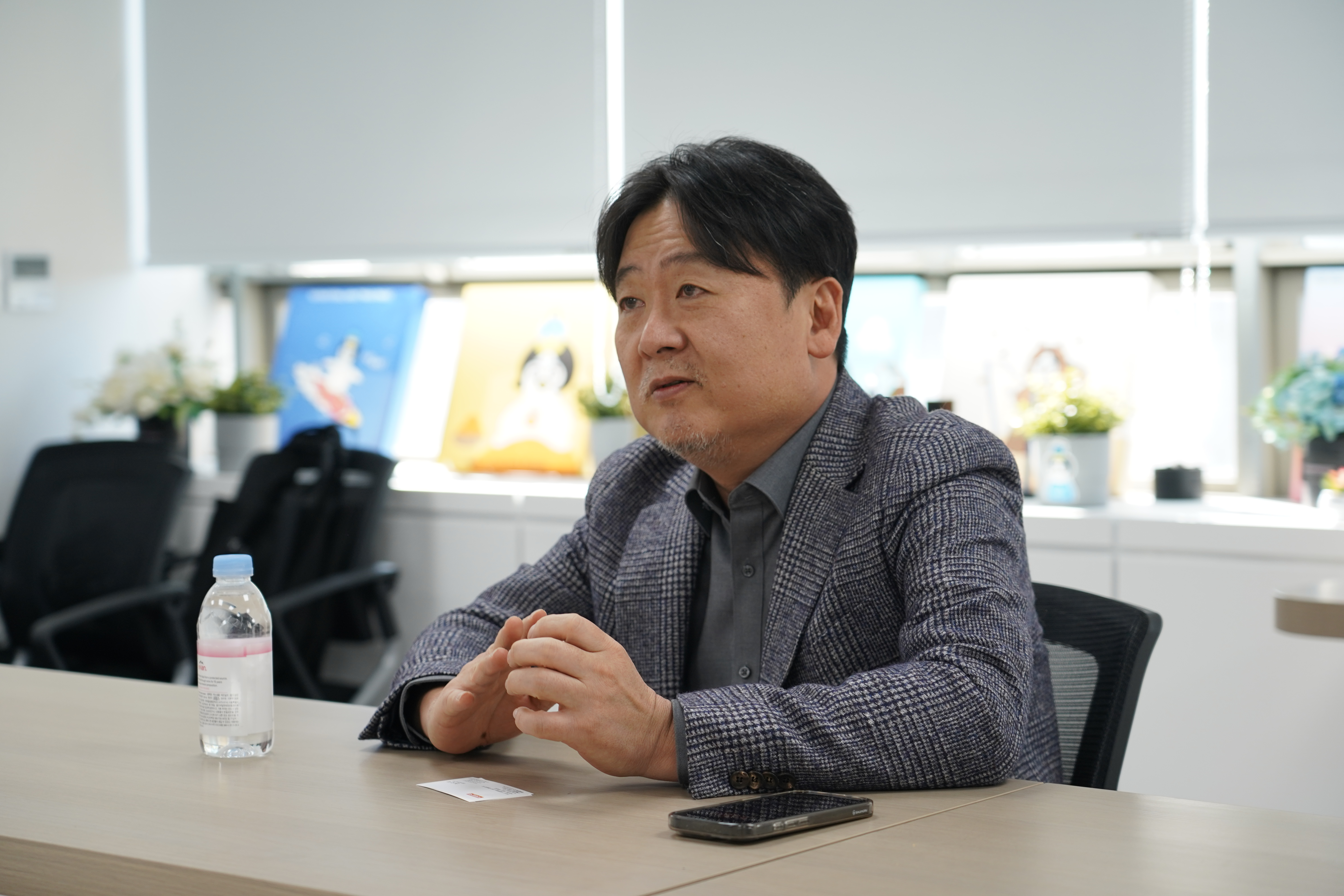
"We plan to lead the Physical AI market centered on 'GPUBase' and 'AgentBase,' the core engines of 'Jonathan,'"
said Ikjun Yeom, CTO (Chief Technology Officer) of ACRYL (0007C0), a company specializing in integrated AI Experience (AX) infrastructure, in an interview with Edaily on the 26th. He added, "Jonathan goes beyond simple software to serve as 'the brain and neural network of Physical AI,' enabling various robots and sensors to operate efficiently based on Neural Processing Units (NPUs)."
Founded in 2011, ACRYL is a company that has pioneered Korea's artificial intelligence industry by developing emotion recognition engines, and listed on the KOSDAQ market in December last year. AX refers to an experience system where companies go beyond simply 'adopting' AI technology to design and operate AI centered on the value and efficiency actually experienced by customers, users, and organization members.
CTO Yeom emphasized, "Just as Apple led a paradigm shift through the iPhone—focusing on 'User Experience (UX)' rather than hardware performance competition—in the era of AI transformation, it is AX, not model performance, that determines corporate competitiveness."
The core product of ACRYL is the AI platform Jonathan. Jonathan maximizes Graphics Processing Unit (GPU) performance, enabling faster development, deployment, and operation of more models with the same resources, thereby revolutionizing enterprises' AI cost and efficiency structures. In particular, GPUBase, the GPU optimization engine embedded within Jonathan, is an AX infrastructure engine that provides △GPU resource efficiency maximization △improved training and inference speeds △operational cost reduction.
CTO Yeom explained, "GPUBase is ACRYL's representative flagship product, born from combining network and system technologies with ACRYL's AI technological capabilities. It is a GPU management and operation platform that maximizes AI infrastructure performance." He added, "There are countless cases where expensive GPUs are purchased but actual utilization is only 50-60%. GPUBase plays the role of finding this 'hidden inefficiency' and converting it into performance."
The core technologies of GPUBase are divided into two axes: 'computing optimization' and 'communication optimization.' CTO Yeom said, "What I particularly want to emphasize is the network (communication) technology. We applied 'multipath transmission' and 'traffic differentiation' technologies to resolve bottleneck phenomena that occur when hundreds of GPUs simultaneously exchange data. Thanks to this, GPUs perform computations continuously without stopping."
Having externally validated this technological stability, ACRYL recently joined the 'NVIDIA Connect Program' as a member. The NVIDIA Connect Program is a global partnership program that provides companies with AI capabilities priority access to the latest AI frameworks, model optimization workshops and technical consulting, joint marketing and sales collaboration, and more. He said, "This means ACRYL's solution has been officially verified for technical compatibility within the NVIDIA ecosystem." Other clients include Samsung E&A, Samsung Welstory, Samsung Seoul Hospital, Seegene, Chungcheongbuk-do Province, and Daegu Metropolitan City.
ACRYL plans to advance in the Physical AI market centered on GPUBase, the core engine of Jonathan, along with 'AgentBase,' which connects AI infrastructure and data. CTO Yeom stated, "Physical AI requires robots or drones to interact with the actual physical world, so advanced infrastructure and intelligent systems beyond simple computation are essential. ACRYL supports VLA (Vision-Language-Action) models that combine Vision and Action beyond simple language models. This dramatically improves the accuracy and efficiency of robot intelligence."
He added, "We are
currently conducting stability tests on a scale of 1,000 GPUs with a domestic
cloud company and aim to verify 3,000 units by the end of the year. After
verification, we plan to enter the U.S. as our primary target market."
Original Article: